
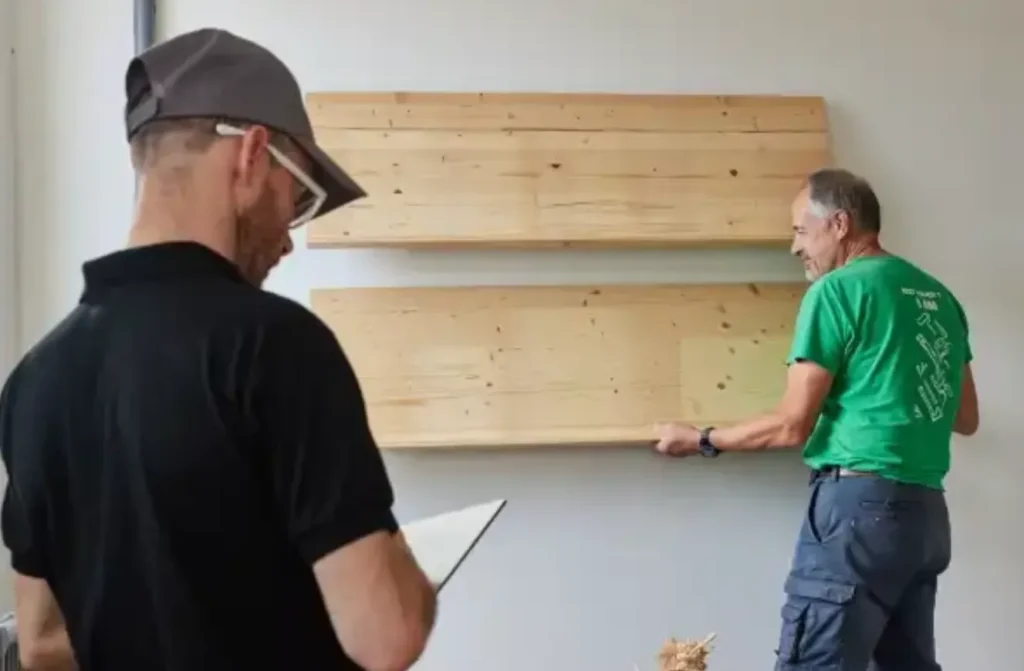
Booking handyman help in Toronto should be simple, and for people who have done it a few times it is. But for first-time homeowners, new condo owners, and anyone who has just moved to the city, the process carries enough small friction points that it is worth laying out clearly. How to describe a job so you get an accurate quote. What information a provider actually needs before they can price the work. How to compare quotes that look different on the surface. And how to avoid the two or three booking mistakes that cost Toronto homeowners the most time and money every year.
The friction is not the providers’ fault, and it is not the homeowners’ fault either. It comes from the sheer variety of Toronto’s housing. A request as simple as “I need a TV mounted” means something different in a concrete-walled King West condo than in a plaster-walled Riverdale semi than in a drywall-framed Scarborough bungalow. The provider cannot give an accurate quote without knowing which, and the homeowner often does not know that the wall type is the single most important detail. Bridging that gap is most of what makes a booking go smoothly.
The most efficient way to start is to compare a few providers at once and read how they describe the work they take on. Browsing Handyman in Toronto listings lets you see current pricing, read recent reviews, and message several providers in one sitting — which is faster than calling around for individual quotes and gives you the side-by-side comparison that makes a good choice obvious.
How to describe a job for an accurate quote
The single biggest driver of quote accuracy in Toronto is wall and surface type. For any mounting or anchoring job, tell the provider whether the wall is drywall, plaster, or concrete. If you do not know, that is itself useful information — a concrete wall in a condo, a plaster wall in a pre-war home, and a drywall wall in newer construction each carry different tools, time, and price. A provider who receives “TV mount, concrete condo wall, 65-inch, cables hidden” can quote accurately in one message. A provider who receives only “need TV mounted” has to either pad the quote for uncertainty or schedule a visit just to assess.
The same principle applies across job types. For a faucet replacement, mention the age of the home and whether the shut-off valves look original — in a pre-war Toronto home, this determines whether the job stays within handyman scope. For any condo work, name the building or at least confirm it is a condo, so the provider can account for elevator booking and access rules. For drywall or plaster repair, say which it is. The more precisely you describe the surface and the home, the more accurate and competitive the quotes you receive.
What information providers actually need
Before a Toronto provider can give a firm quote, they generally need four things: what the job is, what the surface or system is, the access conditions (house with a driveway, or condo with elevator booking and work-hour restrictions), and whether materials are being supplied by you or sourced by them. A message that covers all four usually gets a firm quote back. A message missing any of them usually gets a range or a request for a site visit, both of which slow the process down.
Photos help enormously. A photo of the wall, the existing fixture, the access path, or the problem area lets a provider quote with confidence and dramatically reduces the back-and-forth. For condo work specifically, a photo of the wall where the work will happen often answers the concrete-versus-drywall question that determines the price.
How to compare quotes that look different
Three Toronto quotes for the same job will often look different on the surface for reasons that have nothing to do with the providers being dishonest. One may include materials; another may not. One may be priced as a flat rate; another by the hour with a minimum. One may account for condo access time; another may not have realized the job is in a condo. The way to compare them is to normalize for these factors — confirm what is included in each, confirm the access assumptions, and then compare the actual all-in cost for the same scope.
When the quotes are normalized, they usually fall within twenty to thirty percent of each other, and the middle quote is most often the right answer. A quote dramatically below the others usually means the provider has missed something — most often the wall type or the access conditions — and the gap tends to reappear during the job. A quote dramatically above usually means a contractor pricing themselves for a handyman task.
The booking mistakes that cost the most
The most expensive Toronto booking mistake is not confirming condo access before scheduling. A provider who arrives at a building without an elevator booking or a certificate of insurance on file gets turned away at the front desk, and the homeowner reschedules around their own calendar a second time. Confirming the building’s requirements before booking eliminates this entirely.
The second most common mistake is booking single jobs one at a time rather than batching. A provider’s minimum-call fee usually exceeds the cost of three or four small tasks handled together. Homeowners who keep a running list and book a half-day visit two or three times a year pay far less per task than those who call every time something needs attention.
The third is failing to confirm scope in writing. Even a one-paragraph message confirming what is included prevents the most common dispute — a homeowner expecting a finished result, a provider expecting to bill by the hour regardless. It is a reasonable thing to ask for and a small red flag if a provider refuses.
The pattern that works
Booking handyman help in Toronto goes smoothly for the homeowners who describe jobs precisely, supply photos, confirm access conditions up front, batch their tasks, and get scope in writing. None of this is complicated, and most of it takes a few extra minutes at the messaging stage. The payoff is accurate quotes, fewer rescheduled visits, lower per-task cost, and a provider relationship that gets easier every time — which, in a city with as much housing variety and as many access quirks as Toronto, is genuinely worth the small upfront effort.
